Rocla Automated Guided Vehicle - Automated Trucks for Logistics
Automation, the Engine of Logistics Performance
For over 30 years, Rocla AGV Solutions has developed recognized expertise in automated guided vehicles (AGV – Automated Guided Vehicle).
In partnership with Aprolis, Rocla offers automated trucks capable of optimizing logistics flows, improving safety and freeing your teams from repetitive tasks.
Each AGV integrates into your warehouses and factories with minimal modifications, allowing a gradual transition to automated and competitive logistics.

The Advantages of Rocla Automated Guided Vehicles
24/7 Productivity
AGVs operate continuously, reduce transfer times and increase output, even in high-commitment environments or shift work.
Enhanced Safety
Compliant with ISO 3691-4 standard, Rocla AGVs are equipped with 360° sensors, proximity detection systems and light/sound signals to coexist safely with operators and manual forklifts.
Flexibility and Scalability
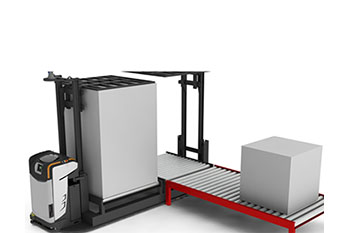
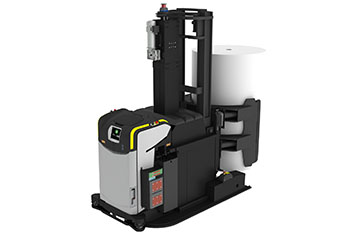
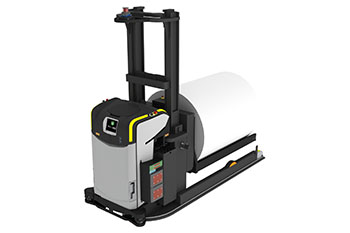
From handling standard pallets to managing specific loads (rolls, reels, paper bales), Rocla automated trucks offer a complete and modular range to meet every need.
Rocla Automated Guided Vehicle Models
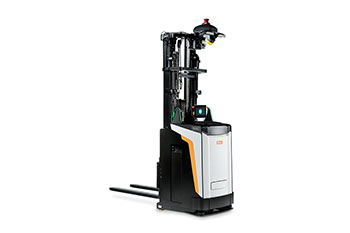
- Capacity: 1.6 t
- Lift up to 6 m in 2.6 m aisles
- iF Design Award & Red Dot Award 2024 winner
- Safety: 360° detection, visual and audible signals
- Intuitive touch interface and communication LEDs
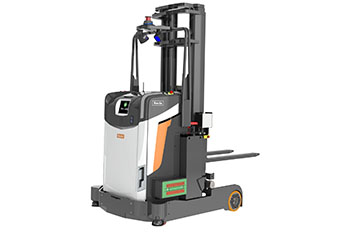
- Capacity: 1.6 t
- Lift height: up to 10 m
- Aisle width: from 2.85 m
- Red Dot Design Award 2025 winner
- Intelligent dynamic stability systems and obstacle detection
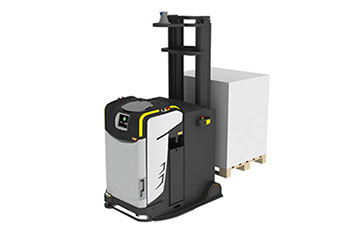
- Capacity: up to 2.5 t
- Lift height: 8.5 m
- Compatible with drive-in, push-back, gravity racking
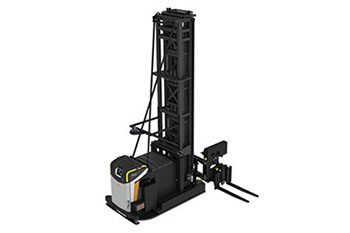
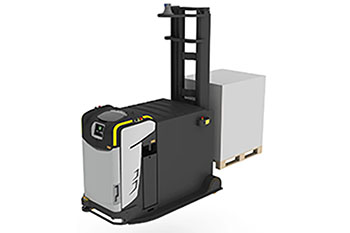
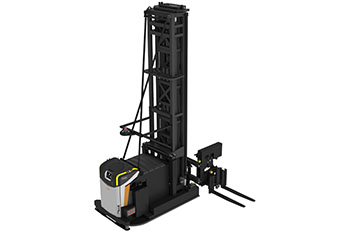
- Capacity: up to 1.2 t
- Lift height: 12.5 m
- Ideal for very narrow aisles (VNA)
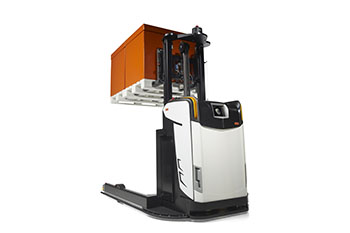
- Capacity: up to 2.5 t
- Lift height: 8.5 m
- Adapted to specific loads and pallets in distribution and manufacturing sectors
Which Rocla Automated Guided Vehicle to choose?</
| Criteria | Rocla ACT | Rocla ART | Rocla AWT25cf | Rocla AWT12ct/s | Rocla AWT25sf |
|---|---|---|---|---|---|
| Type | Compact truck | Reach mast | Counterbalance | Tridirectional or bidirectional | Straddle stacker |
| Capacity | 1.6 t | 1.6 t | 2.5 t | 1.2 t | 2.5 t |
| Max lift height | 6 m | 10 m | 8.5 m | 12.5 m | 8.5 m |
| Min aisle width | 2.6 m | 2.85 m | From 3.5 m | VNA narrow aisles | From 3.3 m |
| Main use | Confined spaces | High storage | Bulk storage | High-bay storage | Specialized stacking |
| Racking compatibility | Standard | Standard | Drive-in, Push-back, Gravity | Standard | Standard + specific |
| Key sectors | Distribution, Retail | Logistics warehouses | Heavy industry | Logistics | Paper, Packaging |
| Awards | iF Design 2024, Red Dot 2024 | Red Dot 2025 | - | - | - |
| Ideal for | Mixed operations (AGV + manual) | Vertical space optimization | Intensive pallet flows | Storage massification | Non-standard loads |
How to Choose Your AGV?
- You have confined spaces? Choose the Rocla ACT (2.6 m aisle)
- You store at height (+8 m)? Choose the Rocla ART (up to 10 m)
- You manage massive pallet flows? The Rocla AWT25cf is made for you
- You handle reels, rolls or bales? The Rocla AWT25sf adapts to your loads
Applications of Rocla Automated Guided Vehicles
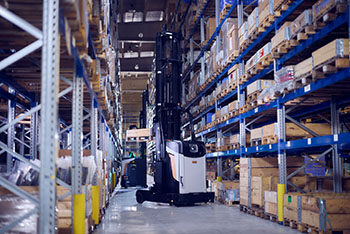
Rocla automated trucks meet many logistics needs.
Thanks to this diversity, Rocla AGV Solutions covers both classic applications (pallet flows) and the most demanding needs (paper, packaging, printing, plastics).
Customer Testimonial – Colart, Logistics 4.0
Discover in video how Colart modernized its logistics thanks to Rocla AGVs.
The automated trucks enabled:
- Reduce accidents thanks to detection systems
- Accelerate internal deliveries
- Develop operator skills related to new technologies

Complete FAQ - Everything You Need to Know About Rocla Automated Guided Vehicles
What is an automated guided vehicle (AGV)?
An AGV is an automated vehicle that moves without a driver, thanks to intelligent navigation and sensors.
What is the difference between an AGV and an automated truck?
The term AGV refers to all automated guided vehicles. The automated truck is a variation, dedicated to logistics flows (pallets, storage, stacking).
What is the difference between an AGV and an AMR (autonomous mobile robot)?
AGVs (Automatic Guided Vehicles) are automated vehicles mainly used indoors for a wide variety of industrial applications. They can transport heavy loads (1,200 to 8,500 kg) and rise up to 12.5 m. Their movement relies on structural guidance technologies: laser triangulation, magnetic guidance or wire guidance.
AMRs (Autonomous Mobile Robots) transport more varied loads, ranging from small loads to pallets, from 350 kg to several tons. Very present in automotive, aerospace or food processing, they are distinguished by the use of natural navigation, allowing them greater flexibility and adaptation to the environment.
What is the autonomy of a Rocla AGV?
Rocla AGVs operate 24/7 thanks to latest generation pure lead batteries with opportunity charging system (fast charging during flow breaks). Typical autonomy: 8 to 10 hours depending on usage intensity. [Lithium battery option available on request]
How many pallets can a Rocla AGV move per day?
Depending on the model and application, between 150 and 400 pallet movements per day per AGV. The Rocla AWT25cf achieves storage/retrieval rates exceeding 15 pallets/hour.
What is the travel speed of a Rocla automated truck?
Maximum speed: up to 2 m/s (7.2 km/h) in a straight line. The speed automatically adapts according to the load, fork height and proximity of obstacles.
Do AGVs work in cold storage warehouses?
Yes, some models are designed to operate at temperatures of -30°C. Contact us for specific cold storage configurations.
How do AGVs ensure warehouse safety?
- 360° sensors and safety scanners
- Proximity Detection System (PDS) to detect pedestrians and trucks
- ISO 3691-4 compliance
- Automatic slowdown and stop in case of danger
Can an AGV work at the same time as trucks driven by operators?
Yes, Rocla AGVs can work in coactivity. Their 360° detection systems and light/sound signals allow safe mixed traffic (AGV + trucks driven by operators + pedestrians).
What happens if an unexpected obstacle blocks an AGV's path?
The AGV detects the obstacle, slows down then automatically stops at a safe distance. It can wait for the path to be clear to restart.
Do you need to modify your warehouse to integrate a Rocla AGV?
No, Rocla AGVs are designed to adapt to existing infrastructures, even in narrow aisles. Only the installation of charging stations and the navigation system (laser guidance and/or wire guidance) is necessary.
How long does it take to install an AGV system?
Between 4 and 12 weeks depending on complexity: flow study, software configuration, team training. A gradual commissioning allows testing and optimizing before full deployment.
Can you start with 1 or 2 AGVs and then increase the fleet?
Absolutely. The Rocla modular approach allows you to start with a few units and gradually expand the fleet according to your needs and return on investment.
Do Rocla AGVs integrate with my WMS (Warehouse Management System)?
Yes, AGVs communicate with most WMS on the market via standard API (REST) or industrial protocols (OPC-UA). They can receive mission orders, confirm executions and report data in real time.
What is the price of a Rocla automated guided vehicle?
The cost varies depending on the model, options and fleet size. Count on an investment comparable to 3-5 years of forklift operator salary costs. Contact Aprolis for a personalized quote and ROI study.
What is the return on investment (ROI) of an AGV?
The average ROI is between 18 and 36 months depending on:
- Productivity gains (24/7 without breaks)
- Reduction of accidents and product damage
- Reduction of turnover (job revaluation)
What are the maintenance costs of a Rocla AGV?
Annual preventive maintenance + wear parts (casters, sensors). Cost lower than maintaining a thermal truck.
Lithium batteries require very little maintenance, as they require no water maintenance and offer a lifespan approximately three times longer than lead batteries. They also handle partial and frequent recharges very well, making them suitable for intensive cycles.
Pure lead batteries, on the other hand, are an improved alternative to conventional lead batteries. Thanks to their design, there is no water topping up, which reduces maintenance operations. They also tolerate opportunity charging, allowing more flexible use while maintaining good performance over time.
What applications do Rocla AGVs cover?
- Pallet transfer
- High-bay storage
- Narrow aisle stacking
- Automated conveying
- Handling of reels, rolls, paper bales
Can an AGV be used for handling hazardous products?
Yes, some models have ATEX certifications for explosion risk areas. AGVs eliminate human risks when handling chemical, toxic or flammable products.
What benefits for the paper and packaging industry?
Specialized AGVs (Reel Fork, Roll Clamp, Bale Clamp) ensure safe transport, without product damage, with traceability and accident reduction. Perfect for paper reels, plastic rolls, pulp bales.
Do AGVs replace human operators?
No, they complement them. AGVs take charge of repetitive and arduous tasks, allowing operators to focus on higher value-added missions: supervision, quality control, maintenance.
What training to operate an AGV system?
Training of 4 to 6 hours depending on the profile (supervisor, maintenance technician). Forklift operators become AGV operators, with valuable skills upgrade.
How to manage change management when AGVs arrive?
Aprolis supports your teams: transparent communication, complete training, operator involvement from the pilot phase. Experience shows excellent acceptance when ergonomic benefits are explained.
Are Rocla AGVs eco-friendly?
Yes:
- 100% electric (zero local emissions)
- Lithium or recyclable lead batteries
- Energy optimization (regenerative braking)
- Carbon footprint reduction vs thermal trucks
What is the lifespan of a Rocla AGV?
Between 10 and 15 years with appropriate maintenance. Components are scalable (software updates, battery replacement) to extend lifespan.
Can't find the answer to your question?
Contact our Aprolis experts for personalized support: flow audit, on-site demonstration, free feasibility study.