Cat® Electric Forklift Truck - Performance, Safety and Decarbonization
What is an electric forklift truck?
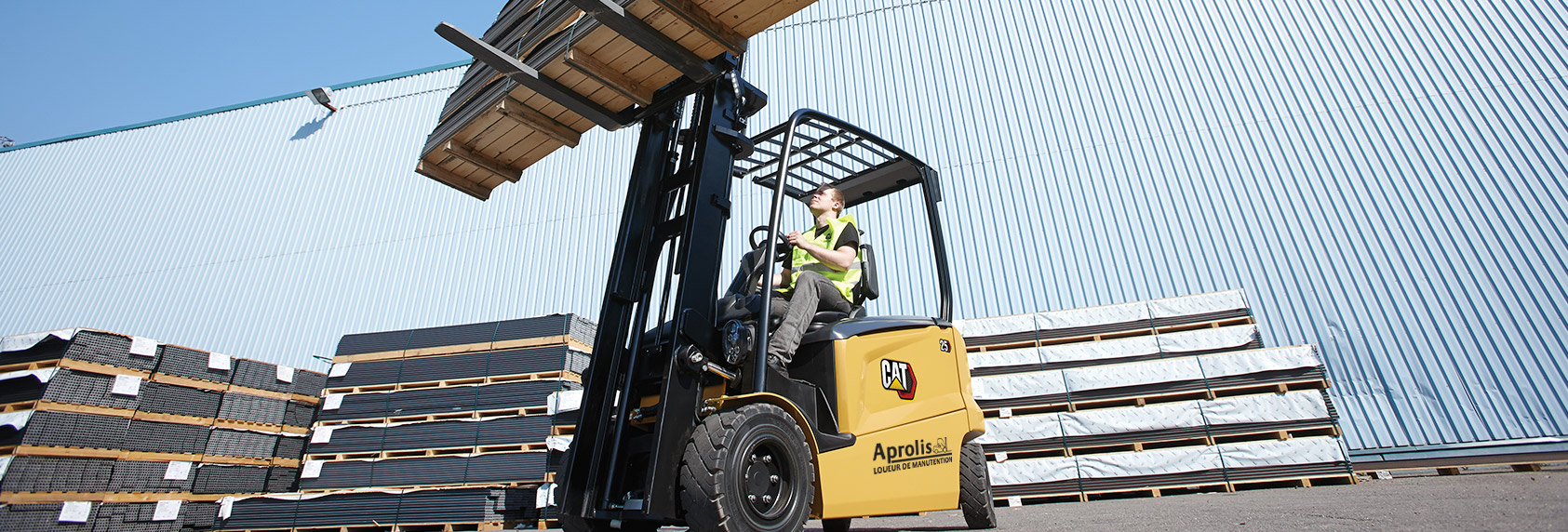
An electric forklift truck is an industrial handling device powered by a battery, designed to transport, lift, stack, and move palletized goods in warehouses, factories, or logistics centers. Unlike thermal models, it uses an electric motor that converts battery energy into mechanical energy to drive the wheels and activate the lifting mechanism.
The counterbalanced electric forklift truck remains the most versatile, capable of lifting loads from 1,400 to 12,000 kg with excellent stability. Electric forklift technology has evolved considerably with the integration of high-performance lithium-ion batteries and intelligent electronic systems. These innovations deliver performance equal to or greater than thermal models, while eliminating emissions and noise. The modern electric forklift combines power, autonomy, and environmental respect.
Why choose electric in 2025?
Economic advantages
Electric forklifts consume less energy than their thermal counterparts, resulting in significantly lower operating costs. Electricity remains cheaper than diesel or LPG, and electric motors require far less maintenance. With no oil changes, filters, or complex engine parts, electric forklifts reduce maintenance costs while maximizing uptime.
Ecological and legal benefits
Zero direct emissions: no exhaust gases or fine particles when using an electric forklift. This improves air quality and complies with increasingly strict standards. Many regulations now restrict the use of thermal engines indoors. The electric forklift significantly reduces the carbon footprint of companies committed to CSR initiatives.
Comfort and safety gains
The quiet operation of the electric forklift improves working conditions and reduces hearing fatigue. With fewer vibrations, driving comfort is superior. Its maneuverability in confined spaces is another key benefit. The absence of hazardous fuel storage eliminates fire risks and enhances site and operator safety.
Choosing the right equipment: forklift, pallet truck, or electric stacker?
The choice between an electric forklift, electric pallet truck, or electric stacker depends on your operational needs.
The electric pallet truck: for horizontal movement
The electric pallet truck is ideal for moving loads from point A to point B at floor level, without high stacking. Compact and maneuverable, it excels in loading/unloading and order-picking operations. Its affordability and simplicity make it a staple tool. However, it cannot stack or lift high, limiting its use to horizontal movement.
The electric stacker: an interesting compromise
The electric stacker allows both horizontal movement and vertical storage, typically up to 4 or 5 meters. This versatility makes it a popular choice for medium-sized warehouses. However, its lifting capacity is limited (usually up to 1,600 kg), and its stability is lower than that of an electric forklift. The electric stacker suits light storage but shows its limits with heavy loads or intensive use.
The electric forklift: power and versatility
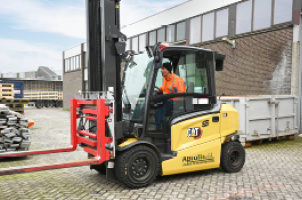
For demanding applications requiring power, stability, and high lifting heights, the counterbalanced electric forklift is the best choice. It can lift from 1,400 to 12,000 kg up to 7 meters, offering unmatched versatility. Its counterweight design ensures excellent stability. The Cat® electric forklift can be used both indoors and outdoors.
| Criteria | Electric Pallet Truck | Electric Stacker | Electric Forklift |
|---|---|---|---|
| Load capacity | Up to 2000 kg | Up to 1600 kg | From 1400 to 12000 kg |
| Lifting height | ~20 cm | Up to 5 m | Up to 7 m and more |
| Stability | Good at ground level | Average | Excellent |
| Environment | Indoor | Indoor | Indoor and outdoor |
Why choose a Cat® electric forklift?
A sustainable alternative to thermal forklifts
Cat® electric forklifts are a credible alternative to diesel or LPG models. They reduce on-site emissions (zero emissions during use), lower noise levels, and decrease the overall carbon footprint of your fleet. This transition supports a sustainable development strategy and compliance with environmental standards.


Performance for all environments
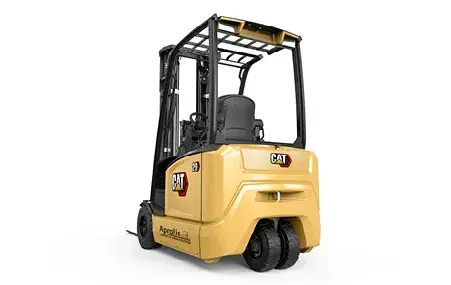
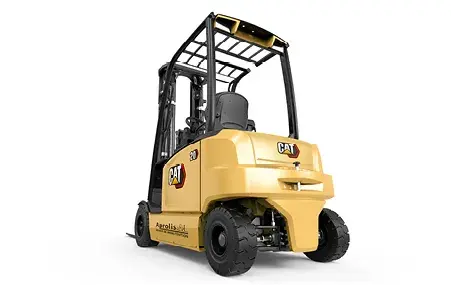
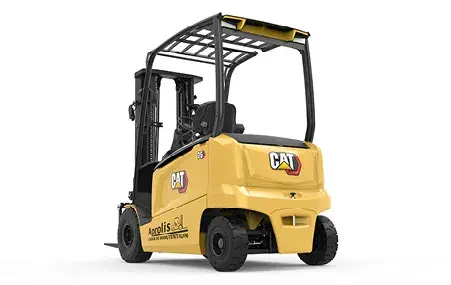
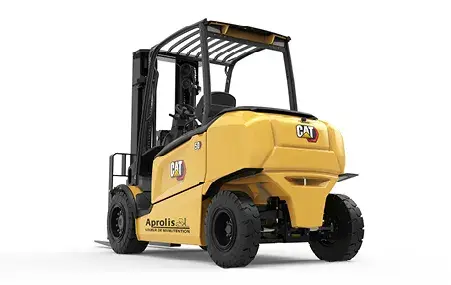
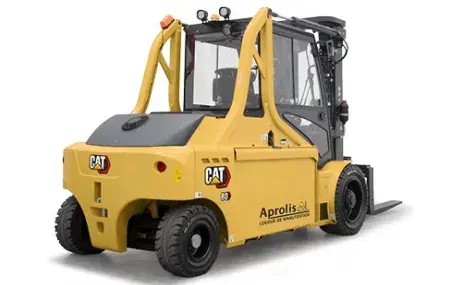
The Cat® electric forklift range meets every need. The exceptional maneuverability of 3-wheel models (EP14-20(C)N2T) makes them ideal for narrow aisles. Lifting heights up to 7 meters optimize vertical storage. High-capacity models (EP40-55(C)N(H), EP60-120N(H)) handle extreme loads. Both indoor and outdoor use offer unmatched versatility.
Why choose Cat® for your electric forklift?
Among numerous brands (Fenwick, Toyota, Jungheinrich, Still...), Cat® Lift Trucks stands out for robustness, agility, and advanced driving-assist technology. Designed for tough environments and intensive applications, they are especially valued in heavy industry and demanding outdoor operations.
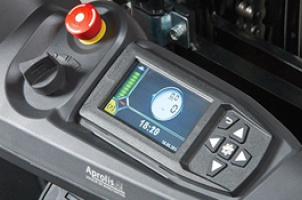
Distinctive technological features
- Responsive Drive System (RDS2): Automatically adjusts performance based on operator behavior for optimal responsiveness and energy efficiency.
- OmniTurn Steering: Rear axle turning over 100° for exceptional maneuverability in tight spaces.
- SmoothFlow: Optimizes mast movement according to load and height for smooth, precise handling.
- Automatic diagnostics: Multifunction display and easy maintenance minimize downtime.
Safety and comfort
ECO and PRO modes
Adapted to operator experience or desired performance.
Ergonomic cabin
Comfortable seats, intuitive controls, and excellent visibility.
Zero emissions
Perfect for food, pharmaceutical, chemical, and automotive industries.
Daily comfort, safety, and productivity
Ergonomics designed for the operator
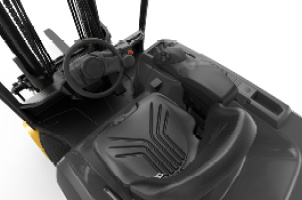
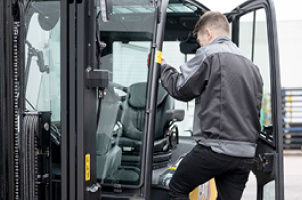
Cat® designs its electric forklifts around the operator: open workspace, suspended seat, accessible controls, readable dashboard. Easy access with low steps and ergonomic handles enhances safety. The panoramic view thanks to optimized pillars increases operational safety.
Built-in technologies
- High-efficiency motors: Optimal torque, controlled acceleration, reduced energy use.
- RDS2 system: Adjusts performance in real time for smooth movement.
- Curve Control: Adjusts cornering speed to enhance stability.
- SmoothFlow: Fast, precise, fluid mast movement based on load.
- PASSIVE SWAY CONTROL: Reduces mast oscillation for greater stability.
- Automatic speed limitation: Reduces speed above 3.5 m for added safety.
- Automatic parking brake: Prevents unintended movement.
- Anti-roll system: Keeps the truck stationary on slopes.
Customize your electric forklift
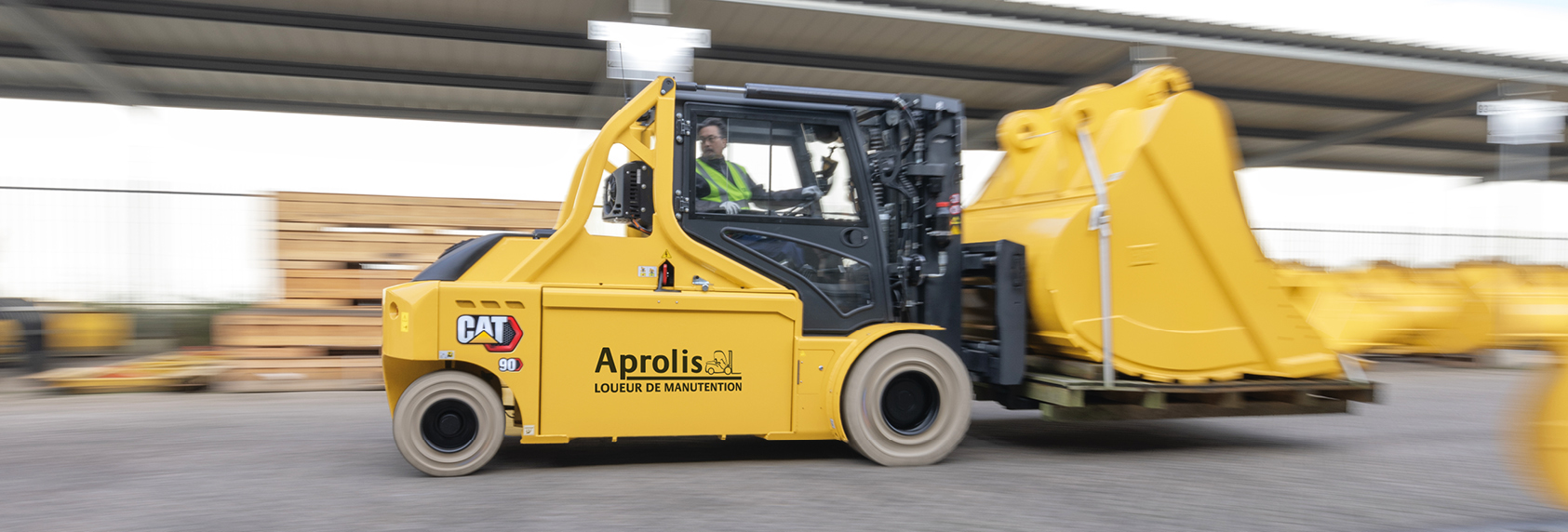
Optional features
- Comfort cabins: Heating, air conditioning, defrosting windshield for outdoor use.
- Non-marking tires: Protect sensitive floors.
- Rear-view cameras: Enhance visibility and safety.
- Flashing beacon: Visually signals the truck’s presence.
- Blue Spot: Projects a blue light on the ground to warn of approach.
- Red Lights: Define a safety zone around the electric forklift.
Electric forklift price: investment and profitability
The price of an electric forklift depends on capacity, lifting height, options, and battery type. Although initial investment is higher, long-term savings are substantial due to lower energy costs, simplified maintenance, and longer lifespan. Lithium-ion batteries, more expensive upfront, offer quick ROI thanks to their superior efficiency and zero maintenance.
Electric forklift rental: flexibility and budget control
Long-term electric forklift rental offers several benefits: no upfront investment, preserved cash flow, maintenance included, regular renewal, and adaptation to workload variations.
Aprolis also offers short-term electric forklift rental for activity peaks, allowing you to test different models before purchase.
Used electric forklift: an economical option
Buying a used electric forklift is a cost-effective option for smaller budgets. Cat® electric forklifts refurbished by Aprolis undergo strict quality control and complete reconditioning, offering near-new performance at a reduced price. Used forklifts come with warranty and optional maintenance contracts.
Choose lithium technology: the Aprolis energy solution
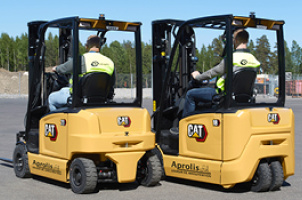
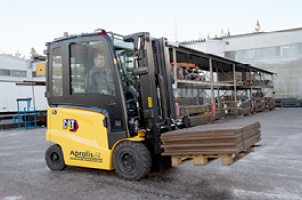
High-performance lithium-ion batteries for your electric forklift
To maximize performance, Aprolis offers innovative lithium-ion batteries. These allow opportunity charging without affecting lifespan, enabling near-continuous use. They reduce electricity consumption by up to 28% compared with lead-acid batteries.
Maximum safety is ensured through the Battery Management System (BMS) and reinforced lithium cell design. This 100% maintenance-free solution eliminates water refilling and extends forklift uptime. Lithium-ion batteries support energy transition goals and reduce extractive activities.
Buy or rent? A flexible solution with Aprolis
Whether you wish to buy or rent your electric forklift, Aprolis supports you with tailored solutions:
- New or refurbished equipment
- Long-term rental contracts
- Short-term rental
- Integrated maintenance
- Personalized fleet optimization advice

Your questions about electric forklifts
1. What is the autonomy of an electric forklift?
Autonomy depends on battery type and usage intensity. With a traditional lead-acid battery, expect 4–5 hours of intensive use. Lithium-ion batteries provide similar runtime but allow opportunity charging (during breaks) without affecting lifespan, enabling near-continuous multi-shift operation. A Cat® electric forklift with lithium-ion can run 24/7 with short 15–30 min intermediate charges.
2. How much does an electric forklift cost ?
Prices vary widely depending on capacity, options, and battery. A standard 1.5–2 t model costs €20,000–€35,000 new. High-capacity models (3–5.5 t) range from €35,000–€60,000. A used electric forklift can save 20–40% depending on age and condition. Rental starts around €300–400/month depending on contract length.
3. Can an electric forklift be used outdoors ?
Yes, Cat® electric forklifts are designed for indoor and outdoor use. With suitable tires, reinforced protection, and optional climate-controlled cabins, they perform well on loading docks, outdoor zones, and stable grounds. Some Cat® models have IP54 protection, ensuring resistance to water and dust. For heavy outdoor use on uneven ground, choose 4-wheel models with higher ground clearance.
4. What’s the difference between an electric forklift and an electric pallet truck ?
The electric pallet truck moves pallets at ground level (10–20 cm lift) with up to 2000 kg capacity. The counterbalanced electric forklift lifts up to 7 m, handles 1500–5500 kg, and offers greater stability. It’s suited for stacking, racked order picking, and outdoor use, unlike the pallet truck limited to indoor horizontal movement.
5. How long does it take to charge a forklift battery ?
Lead-acid batteries need 8–10 hours for full charge plus 8 hours cooling. Lithium-ion batteries charge fully in 2 hours and can recover 20–30% in 15–30 minutes. For multi-shift intensive use, lithium-ion removes the need for spare batteries and maximizes uptime.
6. What’s the lifespan of an electric forklift ?
Properly maintained forklifts can last 10–15 years or more. Cat® chassis and frames are built for 15,000–20,000 hours. Lead-acid batteries last 1500–2000 cycles (4–6 years), lithium-ion up to 5000 cycles (10–15 years). Lifespan depends on usage intensity, maintenance quality, and conditions. Cat® forklifts retain strong residual value even after a decade.
7. What are maintenance costs ?
Electric forklifts cost 30–50% less to maintain than thermal ones. Expect €1,000–1,500/year for full preventive service. Lithium-ion reduces this by another 20–30%. Main costs: annual inspections, tire replacement (every 2–4 years), brakes (3–5 years), and mast maintenance. Aprolis maintenance contracts include labor, parts, and travel for fixed-cost peace of mind.
8. Is a license required to drive an electric forklift?
Yes, CACES® R489 certification is required in France. Categories: R489-3 for ≤6 t forklifts, R489-5 for >6 t. Training lasts 2–5 days and certification is valid 5 years. Employers must also issue a driving authorization after verifying medical fitness, skills, and site knowledge.
9. How to choose lifting capacity?
Choose a forklift rated 20% above your heaviest loads for safety. For 800–1000 kg pallets, 1.5–2 t models are fine; for 1500–2000 kg loads, 2.5–3 t models are better. Capacity decreases with height and load center distance. Cat® forklifts clearly display residual capacity for safe use (load plate).
10. Are electric forklifts suitable for extreme temperatures?
Cat® electric forklifts operate efficiently between -10°C and +40°C. For cold storage (-25°C to -30°C), special models exist with adapted batteries and heated cabins. In hot environments (>40°C), cooling systems and AC cabins maintain performance. Lithium-ion handles temperature variations better than lead-acid. For extreme use, Aprolis experts can configure the best solution.
11. Can I rent an electric forklift short-term?
Absolutely! Short-term rental is ideal for temporary needs — seasonal peaks, replacements, events, or pre-purchase trials. Aprolis offers rentals from one day, with or without operator. Prices are degressive: around €89/day from 4 days. Each rental includes charged battery, charger, and technical support.
12. What are lithium-ion advantages over lead-acid?
Lithium-ion batteries transform forklift use: 5× faster charging (2h vs 8–10h), opportunity charging without wear, zero maintenance (no water filling), twice the lifespan (5000 vs 1500 cycles), +28% energy efficiency, constant performance. The 30–40% higher purchase price is paid back within 3–4 years thanks to operational savings.
13. How to choose between 3-wheel and 4-wheel forklifts?
3-wheel electric forklifts offer unmatched maneuverability in narrow aisles (as little as 2.7 m), with a turning radius 20–30% smaller than 4-wheel models. Perfect for high-density warehouses. 4-wheel forklifts provide better stability for heavy loads and high lifts, ideal for outdoor or uneven terrain. Cat® 3-wheel models (EP14–20N2T) handle up to 2 t; 4-wheel models range from 1.6 to 12 t. Your choice depends on aisle width, loads, and environment.
14. Are electric forklifts really quieter than thermal ones?
Yes, absolutely! An electric forklift emits 65–75 dB during normal operation, compared with 95–105 dB for a thermal model — a reduction of 30 dB, perceived as four times quieter. This major difference greatly improves operator comfort, reduces hearing fatigue and stress, allows easy communication without shouting, and enables shift work without disturbing nearby residents. In food, pharmaceutical, or office environments, the silent electric forklift is indispensable.
15. What lifting height should I choose for my electric forklift?
Your electric forklift’s lifting height should match your tallest racks plus 10–15 cm safety margin. For standard 3–4 m racks, a 4.5–5 m triplex mast works well. Above 5 m, consider aisle width (minimum 3.5–4 m for 6–7 m lifting). Cat® electric forklifts offer masts from 3 to 7 meters. Note: higher lift means reduced residual capacity and greater stability requirements. Aprolis experts precisely size your equipment according to your storage layout.